Showing posts with label Zimbabwe. Show all posts

Wednesday, February 11, 2015

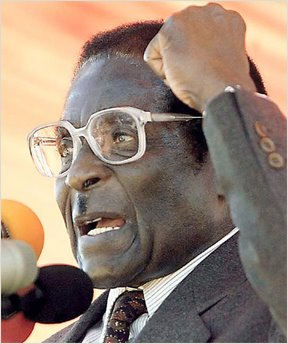
Mugabe's Latest Act of Terrorism

Mugabe Terrorism

Mugabe's Operation Murambatsvina (sweep up the rubbish)

The tragic deaths of three people, including two children (a 4 year old and an 18 month old baby) during the forced destruction of dwellings at Porta Farm on the outskirts of Harare on the 30th June serves to confirm the ruthless nature of Operation Murambatsvina. To date at least eight deaths have been confirmed nationwide. Many more have been reported but cannot be confirmed. These are only the deaths caused, so far, by direct action of the government forces involved, and not other causes as outlined below.

Porta Farm was formed in 1991, when, in an operation much like the current one, hundreds of poor urban squatters were rounded up by police and dumped outside Harare in order to “cleanse” the city in preparation for a visit by Queen Elizabeth II. As now, government had made no arrangements for the care and support of these displaced people and it was left to NGOs and international agencies to provide emergency relief.

In 14 years Porta Farm has evolved into a stable community with clinics, primary and secondary schools, preschools and even an orphanage. This community was obliterated in the space of a day. In clear violation of the International Convention on the Rights of the Child, hundreds of orphans and vulnerable children, together with the families caring for them, have joined the thousands already deprived of shelter, education and health care by Operation Murambatsvina. Seven hundred primary school pupils, 150 of whom were about to write their Grade 7 examination, and 183 secondary school students have been forced to abandon their education, in addition to an estimated 300,000 children similarly affected countrywide.


Below are some of the current and predictable effects of Murambatsvina as outlined by the Zimbabwe Association of Doctors for Human Rights:

  1. The likelihood of further deaths due to intentional physical trauma, as incurred this week in Porta Farm, as a result of the thoughtless violence of the demolition methods, 
  2. Deaths due to exposure and hypothermia among already vulnerable children, chronically ill adults and the elderly, forced to live through nights in the open at the coldest time of the year,
  3. The spread of infectious disease due to the lack of proper sanitation or water supply for hundreds of thousands of people,
  4. The generation of ideal conditions for the spread of epidemic disease (eg cholera and typhoid) from those directly affected into the general population,
  5. The increase in incidence of malnutrition due to the breakdown of food supplies as family income generation methods are destroyed, in a context in which basic foodstuffs are already at a premium,
  6. The exacerbation of the HIV epidemic as community structures are fractured and dispersed and the vulnerability of women, adolescents and children to sexual exploitation is magnified,

The inevitable emergence of widespread drug-resistant HIV as treatment programs are disrupted.

After receiving condemnation from other nations the government of Zimbabwe has tried to say this destruction is just the first stage of “Operation Garikayi (good living)”. Supposedly, the plan is to build thousands of new homes to replace those that have been razed. This is obviously a ruse made up in the face of negative attention: 1) Zimbabwe is bankrupt, it has the fastest shrinking economy in the world ! 2) Zimbabwe’s credit has,rightfully, been cut off by the IMF and the World Bank, 3) nothing was said publicly of this plan prior to Operation Murambatsvina, 4) the Police Commissioner in Harare said on July 3rd, “'We must clean the country of the crawling mass of maggots.”

It has been estimated that nearly 1.5 million people have been made homeless by governmental action in Zimbabwe nation wide, including Operation Murambatsvina. Cotrast this with the tsunami that hit Southeast Asia this year, where just under a million were left homeless, and then compare the reactions: In the case of the tsunami western nations showed how truly humanitarian they can be when they wish to be. People and resources from around the world were mobilized nearly overnight, the situation was stabilized and reconstruction has already begun. In stark contrast is the ongoing willful death and destruction in Zimbabwe. Not an act of nature, but a deliberate act of evil perpetrated by a tyrannical regime. Totally preventable before hand, and stoppable now, and where is the public outcry?

(In the 1980’s, when the apartheid regime of South Africa did the same thing to shanty towns near Johannesburg, millions of people throughout the world demonstrated in protest to bring about change, and they helped to make a great difference. Where are those protestors now? They seem to only care if white men are killing black Africans. If a black regime is killing blacks or white Africans, they don’t care. Unfortunately, the people who helped bring about change only wanted change, they don’t seem to care if the African people are prosperous after that change.)

Monday, March 28, 2011

Zimbabwe’s Chaos: The Powerful Thrive

BULAWAYO, Zimbabwe, July 28 — Earlier this month, shortly after Zimbabwe’s president, Robert G. Mugabe, proposed legislation mandating a gradual transfer of all businesses to what he called “indigenous” ownership, a Zimbabwean businessman said he received an unexpected telephone call. The caller, a stranger, said that he represented a group of indigenous investors.

The investors, he said, would like to discuss the merchant’s plans for complying with the coming ownership law.

There is a flip side to Zimbabwe’s economic decline, critics and analysts contend, and this is it: As 11 million or more people descend into destitution, a tiny slice of the population is becoming ever more powerful and wealthy at their expense.

No one outside of Mr. Mugabe’s inner circle, of course, can say with certainty why he has pursued policies since 2000 that have produced economic and social bedlam. For his part, Mr. Mugabe says Zimbabwe’s chaos is the product of a Western plot to reassert colonial rule, while he is simply taking steps to fight that off.

Among many outside that circle, however, the growing conviction is that Zimbabwe’s descent is neither the result of paranoia nor the product of Mr. Mugabe’s longstanding belief in Marxist economic theory. Instead, they say, Zimbabwe is fast becoming a kleptocracy, and the government’s seemingly inexplicable policies are in fact preserving and expanding it.

“Their sole interest is in maintaining power by any means,” said David Coltart, a white opposition member of Parliament. “I think their calculation is that the rest of Africa is not going to do anything to stop them, and the West is distracted by Iraq and Afghanistan. The platinum mines can keep the core of the elite living in the manner they’re accustomed to — just in a sea of poverty.”

There surely are other views. One influential member of the governing ZANU-PF party said Mr. Mugabe, now 83, was rushing to empower long-suffering black Zimbabweans before he died.

This, he said, explains why the government seized thousands of white-owned farms early this decade, and why Mr. Mugabe ordered manufacturers and merchants last month to reduce their prices by 50 percent and more. To him, it also explains why Mr. Mugabe now proposes to require that every Zimbabwean business be controlled by native Zimbabweans.

“The old man wants to leave a legacy,” said the politician. “He’s in the twilight of his life, and he wants it to be remembered that he left something to Zimbabweans.”

Yet in interviews in Zimbabwe, Mr. Coltart’s view was widely shared by blacks and whites alike, many with no political ax to grind. Even the governing party politician allowed that whatever the aims of Mr. Mugabe’s policies, their execution had gone terribly awry.

Zimbabwe’s farm seizures destroyed the nation’s rich agriculture industry, and, as a form of patronage, vast tracts of land were handed over to party elites with little experience or interest in farming. The looming takeover of businesses is expected to produce the same result.

“Some of these people, his cronies, are being greedy,” the ZANU-PF official said. “That’s the tragedy of this country. Those who benefited from land reform are also going to benefit from this takeover.”

The circumstantial evidence that Zimbabwe’s decline has become a zero-sum game, in which one side’s loss inevitably is the other’s gain, is not easy to ignore.

Zimbabwe’s plummeting currency — 200,000 Zimbabwe dollars now buy a single American dollar on the black market — has rendered the salaries of working Zimbabweans all but worthless. Yet the official exchange rate is not 200,000 to 1, but 250 to 1. Those with connections to the government’s reserve bank are widely said to buy American dollars cheap, sell them dear — and reap an 800-fold profit on currency transactions.


Mr. Mugabe’s government declares currency trading illegal, but regularly dumps vast stacks of new bills on the black market, still wrapped in plastic, to raise foreign exchange for its own needs, business leaders and economists say.

Source: http://www.nytimes.com/2007/08/03/world/africa/03zimbabwe.html


Wednesday, August 20, 2008

Zimbabwe inflation hits 11,200,000 percent

zimbabwe inflationHARARE, Zimbabwe (CNN) -- Zimbabwe's inflation rate has soared in the past three months and is now at 11.2 million percent, the highest in the world, according to the country's Central Statistical Office.

Zimbabwe's inflation rate has soared to a world high.

Official figures dated Monday show inflation has surged from the rate of 2.2 million percent recorded in May, despite the government's price controls.

The country's finance minister confirmed the new figure in an interview but said the rising inflation rate was not confined to Zimbabwe alone.

"While our case has been aggravated by the illegal sanctions imposed by the Western powers, rising food prices are a world phenomenon because of the use of bio-fuel," said Samuel Mumbengegwi. "But we will continue to fight inflation by making sure that prices charged are realistic."

In February, the price of a loaf of bread in the country was less than 200,000 Zimbabwe dollars. On Monday, that same loaf of bread cost 1.6 trillion Zimbabwe dollars.

Analysts have said the Zimbabwean government's official inflation rate figures are conservative. Last week, one of Zimbabwe's leading banks, Kingdom Bank, said the country's inflation rate was now more than 20 million percent.

The locally-owned bank predicted tougher times ahead for Zimbabwe in the absence of donor support and foreign investment in an economy that has been in freefall for almost a decade.

Full article: CNN/world business

Friday, July 11, 2008

Robert Mugabe's militia burn opponent’s wife alive

Mugabe_murder
From The Times
June 12, 2008

The men who pulled up in three white pickup trucks were looking for Patson Chipiro, head of the Zimbabwean opposition party in Mhondoro district. His wife, Dadirai, told them he was in Harare but would be back later in the day, and the men departed.

An hour later they were back. They grabbed Mrs Chipiro and chopped off one of her hands and both her feet. Then they threw her into her hut, locked the door and threw a petrol bomb through the window.

The killing last Friday – one of the most grotesque atrocities committed by Robert Mugabe’s regime since independence in 1980 – was carried out on a wave of worsening brutality before the run-off presidential elections in just over two weeks. It echoed the activities of Foday Sankoh, the rebel leader in the Sierra Leone civil war that ended in 2002, whose trade-mark was to chop off hands and feet.

Mrs Chipiro, 45, a former pre-school teacher, was the second wife of a junior official of the Movement for Democratic Change (MDC) burnt alive last Friday by Zanu (PF) militiamen. Pamela Pasvani, the 21-year-old pregnant wife of a local councillor in Harare, did not suffer mutilation but died later of her burns; his six-year-old son perished in the flames.

Full article: The Times Online

Wednesday, January 23, 2008

Zimbabwe’s Chaos: The Powerful Thrive

By MICHAEL WINES
Published: August 3, 2007

BULAWAYO, Zimbabwe, July 28 — Earlier this month, shortly after Zimbabwe’s president, Robert G. Mugabe, proposed legislation mandating a gradual transfer of all businesses to what he called “indigenous” ownership, a Zimbabwean businessman said he received an unexpected telephone call. The caller, a stranger, said that he represented a group of indigenous investors.

The investors, he said, would like to discuss the merchant’s plans for complying with the coming ownership law.

There is a flip side to Zimbabwe’s economic decline, critics and analysts contend, and this is it: As 11 million or more people descend into destitution, a tiny slice of the population is becoming ever more powerful and wealthy at their expense.

No one outside of Mr. Mugabe’s inner circle, of course, can say with certainty why he has pursued policies since 2000 that have produced economic and social bedlam. For his part, Mr. Mugabe says Zimbabwe’s chaos is the product of a Western plot to reassert colonial rule, while he is simply taking steps to fight that off.

Among many outside that circle, however, the growing conviction is that Zimbabwe’s descent is neither the result of paranoia nor the product of Mr. Mugabe’s longstanding belief in Marxist economic theory. Instead, they say, Zimbabwe is fast becoming a kleptocracy, and the government’s seemingly inexplicable policies are in fact preserving and expanding it.

“Their sole interest is in maintaining power by any means,” said David Coltart, a white opposition member of Parliament. “I think their calculation is that the rest of Africa is not going to do anything to stop them, and the West is distracted by Iraq and Afghanistan. The platinum mines can keep the core of the elite living in the manner they’re accustomed to — just in a sea of poverty.”

There surely are other views.

One influential member of the governing ZANU-PF party said Mr. Mugabe, now 83, was rushing to empower long-suffering black Zimbabweans before he died.

This, he said, explains why the government seized thousands of white-owned farms early this decade, and why Mr. Mugabe ordered manufacturers and merchants last month to reduce their prices by 50 percent and more. To him, it also explains why Mr. Mugabe now proposes to require that every Zimbabwean business be controlled by native Zimbabweans.

“The old man wants to leave a legacy,” said the politician. “He’s in the twilight of his life, and he wants it to be remembered that he left something to Zimbabweans.”

Yet in interviews in Zimbabwe, Mr. Coltart’s view was widely shared by blacks and whites alike, many with no political ax to grind. Even the governing party politician allowed that whatever the aims of Mr. Mugabe’s policies, their execution had gone terribly awry.

Zimbabwe’s farm seizures destroyed the nation’s rich agriculture industry, and, as a form of patronage, vast tracts of land were handed over to party elites with little experience or interest in farming. The looming takeover of businesses is expected to produce the same result.

“Some of these people, his cronies, are being greedy,” the ZANU-PF official said. “That’s the tragedy of this country. Those who benefited from land reform are also going to benefit from this takeover.”

The circumstantial evidence that Zimbabwe’s decline has become a zero-sum game, in which one side’s loss inevitably is the other’s gain, is not easy to ignore.

Zimbabwe’s plummeting currency — 200,000 Zimbabwe dollars now buy a single American dollar on the black market — has rendered the salaries of working Zimbabweans all but worthless. Yet the official exchange rate is not 200,000 to 1, but 250 to 1. Those with connections to the government’s reserve bank are widely said to buy American dollars cheap, sell them dear — and reap an 800-fold profit on currency transactions.

Mr. Mugabe’s government declares currency trading illegal, but regularly dumps vast stacks of new bills on the black market, still wrapped in plastic, to raise foreign exchange for its own needs, business leaders and economists say.

NYTimes.com

Saturday, May 12, 2007

Bloggers turn up heat on Zimbabwe

zimbabwe-policeBBC News
Friday, 16 March 2007, 09:19 GMT

Turmoil in Zimbabwe this week refocused the world's attention on the 27-year rule of President Robert Mugabe. The world of blogging was no exception as the BBC News website discovered.

From Harare, Bev Clark writing on kubatanablogs offered an interesting analogy about the country's situation.

"I've been seeing Zimbabwe like a cake lately," she wrote on the day opposition leader Morgan Tsvangirai, arrested for attending a weekend rally, was taken to hospital after two days in police detention.

"Morgan Tsvangirai, Raymond Majongwe, Mike Davies, and Grace Kwinje (etc) are the candles burning big and bright. The icing is made up of a small section of civic and political activists. While the actual cake itself comprises the Zimbabwean people."

That is not where it ends, the cake, it seems, has just been put in the oven.

"Until we, the Zimbabwean people, come to the party and support civic and political leaders working for change, not much will happen. The cake has got to cook. It's got to get warm, and bake and maybe even burn, but it can't stay like it has been - unmovable.

"Because if it does, no matter how many Highfield rallies we have, and no matter how iconic Tsvangirai becomes, the struggle for freedom in Zimbabwe will remain lop-sided."

The Bearded Man is also not convinced that this is the beginning of the end of Mr Mugabe's rule, as some commentators would have it.

"No doubt the fall-out over this violence will last only a few days before the world neatly sweeps it under the carpet - and the dirty underbelly of African politics..."

He then goes on to echo a plea made by many Western governments to Zimbabwe's immediate neighbours.

"Please would someone out there actually DO something about this Mugabe person?"

'Cowardice'

Who exactly is being asked to do something? Well, South Africa - Zimbabwe's powerful neighbour to the south - for a start.

"South Africa's so called 'quiet diplomacy' has achieved precisely nothing in Zimbabwe," blogged Tony Sharp on The Waendel Journal.

"Its call to Mugabe yesterday to respect the rights of citizens will change nothing. Mugabe, like his ilk elsewhere in the world, recognises cowardice when he sees it and knows that talk is cheap."

In a volatile situation where perceptions of events are so important, The Zimbabwe Pundit - subtitled "the world as seen through the eyes of a Zimbabwean" - seems to be losing patience with the opposition in the country.

"The media in Zimbabwe is owned and operated by the Mugabe regime. So in Sunday's aftermath Zimbabweans are being force fed a diet of MDC thuggery, non-attendance and opposition violence. This makes me wonder when the pro-democracy movement will get its act together in terms of creating its own robust media and information response unit."

Steph's Blog would beg to differ though - and sticks the boot into the BBC while she is at it, comparing a report on violence at an opposition rally on Sunday in state-owned The Herald newspaper with one of ours.

"The Herald is a Zimbabwean government-owned newspaper and the BBC is a British government-owned broadcaster. The Herald's version is pro-Mugabe and pro-police but at least it was there, the BBC wasn't. Its version is MDC propaganda, with a little bit of British imperialism chucked in," she blogged.

"Morgan Tsvangirai is a Western-sponsored 'terrorist', he plotted in London to assassinate Mugabe and overthrow the elected government. There is nothing democratic about the MDC. The only reason the British government is anti-Mugabe is they still consider Zimbabwe to be Rhodesia."

'Breached conditions'

The Radical Soldier of Zimbabwe!, meanwhile, is having none of it and offers what could be a radical solution to challenges facing the country.

"Europe intervened in the Balkans and the 'coalition of the willing' did a job in Iraq, but nobody seems to care about Zimbabwe," he lamented.

"Britain, in my view, has more legal grounds to invade Zimbabwe than it did Iraq. Britain was the former colonial power in Rhodesia and negotiated the Lancaster House Agreement. The agreement is actually worth reading. It sets out the principles under which democratic Zimbabwe should have been governed, and was in fact governed for the first few years.

"Mugabe has clearly violated the agreement. He has breached conditions including white representation in parliament [NB this clause has expired], independence of the judiciary, citizenship and payment of pensions. These should be sufficient grounds for Britain to demand change or otherwise invade. Who knows? Maybe John Howard will even commit a couple of hundred Australian troops."

Laer from Orange County California sees little chance of this happening though - mainly because of another world power.

"The big problem for me is that China doesn't seem to care. It will continue to block UN efforts to protect Zimbabweans from Mugabe, proving once again the powerlessness of the world body," he blogged on Cheat Seeking Missiles.

So is there any hope at all?

"From what I can see, the UN is frozen, the African Union is powerless to do anything, and the world just watches," he said.
Add zimbabwechaos.blogspot.com to your digg account

Thursday, March 23, 2006

Genocide By Other Means


Genocide - When most people hear this word they think of direct systematic killing by firing squads and mass graves. This is indeed the "conventional" method of eradicating another race or religion, or even an opposing political group.

Robert Mugabe used this conventional method in the early 1980's in the Matabeleland area of Zimbabwe. Mugabe (a Shona) sent his North Korean trained 5th Brigade in the hope of eliminating his chief political rivals and tribal enemies. The Matabele people. Conservative estimates say 30,000 people died before outside pressure forced Mugabe to pull out his uniformed terrorists. The 5th Brigade was ultimately disbanded and the thugs were dispersed throughout the regular army.

Mugabe is evil but not stupid. He learned from his failure and now is conducting his genocide by other means. He is no longer limiting himself to the Matabele either. He wants ALL his opponents dead, including his own Shona tribesmen. His new methods are much more subtle and attract much less attention.

Dydimus Mutasa, Mugabe's right-hand man and Minister of National Security and Land, has notoriously shrugged his shoulders at Zimbabwe's high death rate from AIDS and hunger-related illnesses, saying, "We would be better off with only six million people . We don't want all these extra people." (current poplation is 11.5 million)

We've all seen the headlines and primetime TV reports about Rwanda and the Sudan. How many have you seen about the thousands of deaths every week in Zimbabwe, through starvation, AIDS (currently around 50% of adults), malaria, TB, cholera etc., etc., etc.? None! You really have to go looking to find more than a paragraph about Zimbabwe. Of course, most of the people who search for information that hard, are already aware. The word is not getting out.

Most people think these conditions are just a tragic side-effect of an inept government, that has ruined its nation. In reality, he has intentionally created the circumstances which led to the current state of the country. He has continually used food as a political tool, refused aid (both medical and food) from western nations. What food aid does come in is divided among his vassals, before a paltry amount is ditributed to only a few of the poor, and only IF they have their ZANU-PF party card.

He has siezed nearly all of the commercial farms and given the best to his insiders, who don't farm, but use them as weekend retreats. He refuses to give title deeds to the few peasant farmers that have gotten land, therefore they cannot get loans that would enable them to begin farming. Mugabe is a devoted communist, and his plan is obvious; once enough people have died, the remainder will be pushed back to their old villages in the TTLs (Tribal Trust Lands) and all of the farmland in the country will become state owned.

People cannot rise up if they are too weakened by hunger and disease to stand.
Add zimbabwechaos.blogspot.com to your digg account

Tuesday, July 19, 2005

Blog From a Friend


Zim Blog: I choose to fight - for life

BY THE FIGHTER

HARARE - Day 1. The aircraft glided over acres of scorched earth beginning its descent into Harare International Airport. The tawny African savanna was splotched with black inkblots blown artistically across the heart of my homeland - visible scars of what I had only read about in the press abroad. Operation drive out rubbish was quite literally a scorched earth policy.Leaving the airport I passed endless lines of parked cars inevitably ending adjacent to a fuel station. My journey took me through empty streets save for a few weary pedestrians. An African nation void of street vendors and their inevitable crowd of loiterers is indeed a peculiar sight. The few motorists on the road were uncharacteristically polite, giving way as others swerved to avoid potholes and driving slowly, presumably to conserve fuel.

I stopped to offer a lift to a familiar gent who lived near me. "Oh thank you boss!" he exclaimed amiably. I had given up asking him not to call me "boss" years ago. An aged domestic worker in Zimbabwe is not likely to grasp the concepts of equality, self worth, liberty or empowerment. Servitude and submission have been legislated into this culture for centuries. This may explain why despite the despicable state of affairs, government's appalling mismanagement and gross human rights violations there have been no mass uprisings.

"How are things?" I asked casually, authentically curious though cautious - in Zimbabwe this is an invitation to engage in a lengthy discussion about hardship, shortages, inflation and politics. "Aah, things are tough," the greybeard sighed. In the few days that have passed since then I have grown to despise a number of clichés, such as: "That is life." "What can you do?" "I can't complain."

What? And always said with a straight face or a half smile that causes one to question the speaker's sincerity. "It can't go on forever." Forever? Three days has been long enough in my experience. Common advice includes, "Just keep your head down and things will be alright." I find myself struggling to refrain from shaking people daily and screaming "This is not just life. This is not how things are supposed to be and there is plenty that you can do, yes you!" It's not alright and it is not going to end soon.

If I want to live here I have to make a choice - either bury my head in the dirt with the rest of the population, or strive to teach, inspire, empower and uplift my countrymen and my own fettered spirit. I choose to fight - for life, liberty and happiness.

Day 2. "Ah come on, what's this?" cried the distressed youth as his bag disintegrated in his hands under the strain of a thick blanket and a few belongings. "Ha ha another Zhing Zhong special!" teased his comrades. This derogatory term has become common-place in the new Zimbabwe. It refers to poor-quality Chinese imports. This tide of neo-colonialism ushered in by the government's "Look East" policy has many citizens bemused.

The implications, however, remain deeply misunderstood and usually amount merely to an exchange of comical remarks. As I explored the phenomenon further the truth and depth of the occurrence was made frighteningly clear to me.

A Chinese businessman explained that China, for the next 10 years, must build a city the size of Johannesburg every six weeks in order to keep pace with the rapid growth (50 million people a year) of its population. In addition, this population requires natural resources to sustain it.

My teacher painstakingly explained that every continent on the planet was more or less spoken for in terms of ownership, governance and stability. That is except for Africa - A continent that accounts for just 10 percent of the global population and yet possesses one third of the world's total natural resources. The reason for China's apparent interest and attempts to develop and invest in Africa suddenly became frighteningly obvious.

How could we have missed this? Why are we openly inviting such blatant exploitation and colonization? I am once again floored by the shortsightedness and greed of our leaders as they barter my heritage and pad their pockets. Where is the world? And when will they realize that they too face a dangerous future at the mercy of a China growing in power, influence and control. Perhaps I will laugh when a Zhing Zhong microphone falters during the next televised international political address. Probably not. Do you like Chinese food? I do. Perhaps that is a good thing.

Day 3. I am today deeply disturbed by the news of recent terror attacks in London. Like many Zimbabweans I have many friends and family in the vicinity. I am reminded that suffering and security are not purely Zimbabwean concerns - though only here we fear our government and not some ill-informed terrorist group. Our terror is legislated.

Attacks do not cause alarm - merely pain. Police uniforms appear on Zimbabwean streets as menacingly as Al-Qaeda t-shirts would at JFK airport in New York City. I mourn for the victims of this new wave of attacks and welcome the sufferers into our circle of survivors questioning why? Hatred has a home in the hearts of evil men. Freedom is forged by fierce men who must fight for its familiarity. Tomorrow Londoners will seek the safety of police uniforms. Tonight I wonder where I will run if the vehicle now idling outside my window should turn out to hold those sworn to protect and serve.
Add zimbabwechaos.blogspot.com to your digg account

Friday, July 15, 2005

Media Monitoring Project Zimbabwe - Report

The Media Monitoring Project Zimbabwe
Monday July 4th – Sunday July 10th 2005
Weekly Media Update 2005-25


CONTENTS

1. GENERAL COMMENT
2. PURGE OF THE POOR AND INTERNATIONAL CONCERNS
3. THE ECONOMIC CRUNCH CONTINUES

1. General comment

THE government media’s misinformation campaign reached new extremes this week. These media either distorted or censored stories that portrayed government in bad light, in an effort to minimize the massive humanitarian crisis triggered by government’s Operation Murambatsvina and muffle condemnation of the exercise.

While the private media reported UN special envoy Anna Tibaijuka’s reservations over Murambatsvina, the official media suffocated this news and only selected comments that portrayed her as appearing to legitimise the exercise. This saw the Chronicle and The Herald (8/7) misleading their readers by claiming that the UN envoy had endorsed the government’s brutal purge of the urban poor when they reported her saying that “cleaning up” cities was part of the world body’s ambition.
Apart from distorting Tibaijuka’s comments to justify government’s action, these papers also either censored or dismissed out-of-hand criticism of the clampdown as fabrications of the West while portraying Africa as fully behind Murambatsvina.

For example, The Herald (8/7) sought to downplay the African Union (AU)’s concern over government’s blitz on Zimbabwe’s urban populations by implying that the visit by Bahame Tom Nyanduga, to assess the impact of Murambatsvina, was not sanctioned by the AU but its human rights commission, the African Commission on Human and People’s Rights (ACHPR). To substantiate its claims, the paper then quoted unnamed third party sources narrating how AU Commission chairperson Alpha Oumar Konare had expressed “regret” to Foreign Affairs Minister Simbarashe Mumbengegwi over the failure by ACHPR to follow “proper procedures” in dispatching Nyanduga. The “sources” added that Konare had “pleadingly” told Mumbengegwi that he “stood by Zimbabwe”. No comment was sought from Konare or the AU, whom the private and international media reported as being responsible for sending Nyanduga.

Instead, the paper tried to scandalise the ACHPR, by dishonestly claiming that last year the commission “unsuccessfully tried to smuggle a damning” human rights violations report on Zimbabwe, which the AU had rejected. It deliberately omitted the fact that the African Heads of State adopted the report at the AU summit in January this year after the Zimbabwe government had managed to obstruct its adoption by the AU for nearly a year.

The government media also used a false story distributed by the international news agency, Associated Press, to dismiss international criticism of Zimbabwe as a British plot when The Herald (9/7) refuted the AP report claiming that Russian President Vladimir Putin had described President Mugabe as a dictator. The paper quoted an unnamed diplomatic source saying that an unnamed Zimbabwean government official had exposed Andrew Lloyd, the head of the southern Africa Desk at the British Foreign Office as being responsible for inventing the allegation in a memo to British Prime Minister Tony Blair. But besides quoting a statement from the Associated Press acknowledging it had wrongly attributed Putin’s comments, as well as the Russian ambassador’s dismissal of the story, the paper made no attempt to substantiate its claims, or even to seek comment from the British.

While the government media continues to disregard professional journalistic standards, an offence under the country’s repressive media laws, the government-appointed Media and Information Commission, whose term of office expired last week, has remained deafeningly silent.

2. Purge of the poor and international concerns

MURAMBATSVINA and government’s launch of Operation Garikai, a reconstruction exercise aimed at mitigating the humanitarian crisis caused by its purge of the poor continued to dominate media coverage.

Eighty-nine stories on the matter appeared on ZBH (ZTV [37], Radio Zimbabwe [31] and Power FM [21]) while Studio 7 carried 25 stories. The Press carried 70 reports, 35 of which appeared in the government papers and the remaining 35 in the private Press.
But the dominance of the topic on ZBH did not translate into an informative coverage of the matter.
All its stories glossed over the devastation caused by government’s actions by passively portraying the authorities as addressing the misery through Garikai.
Similarly, 14 (40%) of the 35 stories the government Press carried pursued this theme.
It was this obsession with legitimizing government’s blitz that resulted in its media suffocating the growing international criticism of Murambatsvina.

Neither did they report UN envoy Anna Tibaijuka’s critical remarks on Murambatsvina, portraying her instead, as being satisfied with the operation. The supine tone with which the official media handled the issue was captured by ZTV’s announcement (4/7, 6&8pm) that government’s reconstruction programme, which has “created massive employment”, had begun nationwide.
The station quoted six alleged beneficiaries of Garikai hailing the authorities for allocating them housing stands. It then used their comments to claim that, “Zimbabweans have now begun to appreciate government intentions in embarking on Operation Restore Order and Garikai as they now reap the benefits”.

Without adequately discussing the criteria used to select the beneficiaries, it unquestioningly quoted Harare City Council spokesman Leslie Gwindi saying those being allocated stands are “bona fide beneficiaries who have been displaced” by Murambatsvina and not “ghosts and all these imaginary people who had inundated the city”. This brazen disdain for the victims of the purge went unchallenged.

ZBH’s passivity was also apparent when ZTV (8/7, 8pm) and Power FM (9/7, 6am) reported Local Government Minister Ignatius Chombo saying about 5 000 houses would be built in the “next three weeks” for the victims of Murambatsvina. There was no attempt to question the practicability of such claims.
In fact, the broadcaster’s attempts to present the authorities as committed to assisting those affected resulted in Power FM (6/7, 6am), Radio Zimbabwe (6/7, 8pm) and ZTV (7/7, 6pm) drowning Tibaijuka’s calls on government to urgently provide victims of Murambatsvina with food and shelter in glowing reports on Garikai.
To justify the involvement of the military in government’s exercise, ZTV, Radio Zimbabwe (8/7, 8pm) and Power FM (9/7, 6am) reported “prospective home seekers” as having called on government to expedite the construction of houses by “mobilizing uniformed forces” and “building brigades”.
Tibaijuka’s reservations on the matter and other issues concerning Murambatsvina were censored.

Likewise, all nine stories that the government Press carried specifically on remarks by Tibaijuka omitted her critical observations on Murambatsvina, especially the remarks she made in Bulawayo. The Chronicle and The Herald (8/7), for example, merely portrayed her as supportive of the blitz while The Sunday Mail and the Sunday News (10/7) diverted attention from her remarks by focussing on Bulawayo Mayor Japhet Ndabeni-Ncube’s alleged barring of three government ministers from a meeting his council held with the UN envoy. The government weeklies reported government as contemplating disciplinary action against the mayor, whom “officials” attacked for trying to ridicule “cabinet ministers in front of the UN’s special envoy”. The papers did not seek comment from Ndabeni-Ncube or provide details of his meeting with Tibaijuka.

Instead, the official Press carried four stories, which sought to pre-empt the findings of the UN envoy. For example, The Herald and the Chronicle (9/7) unquestioningly reported Information Minister Tichaona Jokonya as saying government was confident of “a balanced report” from the UN despite the fact that “some members of the opposition were literally taking people to holding camps at night” in order to influence the UN envoy.
The Herald’s editorial also suggested Tibaijuka could only produce a negative report on Murambatsvina as a result of outside influence from the country’s detractors. The paper then drew parallels between Tibaijuka’s mission and that of former Nigerian president Abdulsalami Abubakar, then head of the Commonwealth Observer Mission to the 2002 Presidential poll, whom it falsely accused of having “capitulated to foreign interests” when he condemned the election despite having made “positive comments a few days before the poll”.

The next day, the Sunday News (10/7) quoted Deputy Information Minister Bright Matonga as saying the UN report would be “immaterial” to government whether it is good or bad.
The government media’s partisan approach on the matter was reflected by their dependence on official comment and sympathetic members of the public as shown in Figs 1 and 2.

Fig 1 Voice distribution on ZBH
MED__ Govt.__ Lcl govt. __Foreign__ Alt. __Prof._ Police__ ZanuPF_ MDC _Ordinary Pple
ZTV____ 18____ 6_______ 5________ 5 _____4 ____1 ______0 _______0________ 42___

Pwr FM_ 13 ____1 _______5 ________1 _____4 _____1 _____0 _______0 _________0___

Rad Zim_10____ 0 ______11________ 0_____ 2 ____1 ______1_______ 1_________ 0__

Ttl_____ 41 ____7_______ 21 _______6 ____10 ____3 ______1 _______1________ 42___

Fig 2 Voice distribution in the government Press

Govt__ Local govt.__ Foreign__ Zanu PF__ MDC__ Alternative__ Ordinary__ Unnamed
_32_____ 12_________ 13______ 1_______ 3________ 5__________ 5________ 2____


Notably, most of the foreign voices quoted were sanitized comments made by Tibaijuka. Except for the MDC, almost all other local sources quoted passively amplified the official position.

In fact, the government media’s uncritical conduct resulted in The Herald (7/7) failing to question the logic and possible consequences of the Harare City Council’s unprecedented decision to rescind “all land sale agreements” it made between 1998 and this year and “resell” it at “market rates to the same buyers, where necessary”.
In contrast, the private media was more revealing in their 60 stories, 35 of which appeared in the private Press and the remaining 25 on Studio 7. These media exposed Tibaijuka’s reservations about the mass evictions and the international community’s reaction to the crisis. The private Press also reported on the divisions in government itself over the exercise and the continuing demolitions despite government’s announcement that Murambatsvina was “winding up”.

For instance, the Zimbabwe Independent (9/7) reported that Tibaijuka had criticised the militarisation of Garikai as well as the authorities’ continued reference to the victims of the clampdown as “criminals” and “squatters” during her meeting with government officials in Bulawayo. The paper and Studio 7 (9/7) also cited G8 leaders, the Danish Prime Minister, Australia, New Zealand and UN secretary-general Kofi Annan as having added their voices to the growing criticism.

In another story, the Independent noted that Mugabe had not received the usual energetic support from fellow African leaders at the AU summit in Libya and as a result had returned, “without the moral support he had hoped for from his African brothers to prop up his failed state”.

The Daily Mirror’s somewhat patronising story (5/7), New Zealand and Australia at it again, and all seven stories carried in The Financial Gazette (5/7) on the topic also projected increasing international isolation of Zimbabwe over the blitz.
For example, the Gazette reported the fact-finding delegation from the US Congress as having been “shocked” by the exercise, which it described as a “gross violation of human rights”. It also carried the Associated Press’s false report (see comment above) in which Russia’s President Putin was quoted saying G8 member countries should not be afraid of stopping aid to corrupt “dictators like Zimbabwe’s Mugabe”.
Although The Herald and Chronicle (9/7), carried the AP correction, they made unsubstantiated claims that it was a fabrication by British intelligence. Earlier, The Herald (7/7) attacked Western media and the MDC for peddling “laughable and spurious claims” to “justify the baseless demonisation campaign” against Murambatsvina.

The manner in which the private Press handled the topic was generally reflected in its attempts to balance official comment with alternative views as illustrated in Fig 3. But AP should be censured for its serious inaccuracy and The Financial Gazette should not be shy to carry a clear explanation of AP’s “mistake”.

Fig 3 Voice distribution in the private papers

Govt ___Local govt.___ Foreign___ Zanu PF___ MDC___ Alternative___ Ordinary people
_12_______ 8_________ 23_________ 0_______ 3 ________13____________ 9_____


3. The economic crunch continues

THE government media continued to relay piecemeal reports on the country’s economic meltdown, characterised by crippling fuel and commodity shortages and price increases. For example, although ZBH’s 50 stories on the economy included isolated reports on indicators of economic decline, such as fuel and foreign currency shortages, the broadcaster avoided relating the issues to government’s economic policies.

The government Press adopted a similar stance in its 22 stories on the matter. The papers made no attempt to link the increases in the price of commodities and services to government’s management of the economy. Instead, they tried to shield the authorities by blaming sanctions, the drought and business people for the problems.
For example, the government Press carried five stories that blamed “defiant” retailers and commuter omnibus operators for the sharp rise in bus fares and prices of basic commodities.

The Chronicle (4/7 & 5/7) reported that government would soon “crack the whip” on urban commuter omnibuses who were not following stipulated fares. It reported (4/7) that rural buses were also defying government’s price controls and were sticking to “illegal fares” which they announced without government approval soon after the fuel price increases.
The paper failed to investigate the viability of price controls or relate them to the recent massive fuel increases.

The Herald (4/7) was similarly guilty of blame-shifting when it accused retailers of defying a government directive not to increase commodity prices.
The government media’s blaming of businesses for the galloping cost of living came amid revelations by the Consumer Council that the monthly bread basket of a family of six for the month of June rose to $4.2 million up from the May figure of $3 million. (The Herald, 7/7 and Sunday Mirror, 10/7).
The survey was reportedly conducted before the fuel price increase.

In an effort to give the impression that government was addressing public transport shortages, ZBH carried 14 passive reports on government’s purchase of 69 buses. There was no analysis on whether they would solve the deepening crisis.
The government media’s professional ineptitude in handling the topic was reflected by the official Press’ sourcing pattern, which was typically pro-government. See Fig 4.

Fig 4 Government Press voice sourcing

Govt___ MDC___ Alternative ___Ordinary people
__27____ 4_______ 14_____________ 2_______

In contrast, the private Press provided a clear view of the economic meltdown in 23 reports.
It carried 15 stories on various indicators, including spiralling prices, fuel and commodity shortages and Zimbabwe’s international isolation. Four were specifically on the fuel crisis, while three were on price hikes.
The private Press’ stories categorically noted that the lack of foreign currency, coupled with government’s international isolation would make it difficult to end the economic crisis. For example, The Standard (10/7) revealed that Harare would miss out on the G8’s debt cancellation and aid doubling programme due to its poor international image.
The Independent reported the International Monetary Fund as having said economic recovery was not possible without political reform in Zimbabwe.

However, Studio 7 was largely reticent on the country’s economic decline. Half of the six stories the station carried on the subject were on the G8’s debt cancellation for Africa, with emphasis on Zimbabwe, two were on the alleged firming of the Zimbabwean currency on the parallel market and only one was on maize meal shortages in Mutare.
Ends//

The MEDIA UPDATE was produced and circulated by the Media Monitoring Project Zimbabwe, 15 Duthie Avenue, Alexandra Park, Harare, Tel/fax: 263 4 703702, E-mail: monitors@mmpz.org.zw

Feel free to write to MMPZ. We may not able to respond to everything but we will look at each message. For previous MMPZ reports, and more information about the Project, please visit our website at http://www.mmpz.org.zw/
Add zimbabwechaos.blogspot.com to your digg account