Showing posts with label Mugabe. Show all posts

Wednesday, February 11, 2015

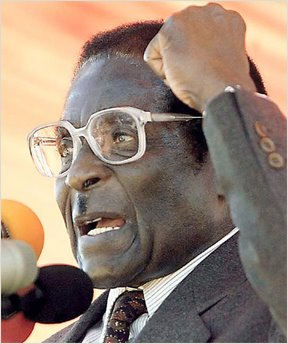
Mugabe's Latest Act of Terrorism

Mugabe Terrorism

Mugabe's Operation Murambatsvina (sweep up the rubbish)

The tragic deaths of three people, including two children (a 4 year old and an 18 month old baby) during the forced destruction of dwellings at Porta Farm on the outskirts of Harare on the 30th June serves to confirm the ruthless nature of Operation Murambatsvina. To date at least eight deaths have been confirmed nationwide. Many more have been reported but cannot be confirmed. These are only the deaths caused, so far, by direct action of the government forces involved, and not other causes as outlined below.

Porta Farm was formed in 1991, when, in an operation much like the current one, hundreds of poor urban squatters were rounded up by police and dumped outside Harare in order to “cleanse” the city in preparation for a visit by Queen Elizabeth II. As now, government had made no arrangements for the care and support of these displaced people and it was left to NGOs and international agencies to provide emergency relief.

In 14 years Porta Farm has evolved into a stable community with clinics, primary and secondary schools, preschools and even an orphanage. This community was obliterated in the space of a day. In clear violation of the International Convention on the Rights of the Child, hundreds of orphans and vulnerable children, together with the families caring for them, have joined the thousands already deprived of shelter, education and health care by Operation Murambatsvina. Seven hundred primary school pupils, 150 of whom were about to write their Grade 7 examination, and 183 secondary school students have been forced to abandon their education, in addition to an estimated 300,000 children similarly affected countrywide.


Below are some of the current and predictable effects of Murambatsvina as outlined by the Zimbabwe Association of Doctors for Human Rights:

  1. The likelihood of further deaths due to intentional physical trauma, as incurred this week in Porta Farm, as a result of the thoughtless violence of the demolition methods, 
  2. Deaths due to exposure and hypothermia among already vulnerable children, chronically ill adults and the elderly, forced to live through nights in the open at the coldest time of the year,
  3. The spread of infectious disease due to the lack of proper sanitation or water supply for hundreds of thousands of people,
  4. The generation of ideal conditions for the spread of epidemic disease (eg cholera and typhoid) from those directly affected into the general population,
  5. The increase in incidence of malnutrition due to the breakdown of food supplies as family income generation methods are destroyed, in a context in which basic foodstuffs are already at a premium,
  6. The exacerbation of the HIV epidemic as community structures are fractured and dispersed and the vulnerability of women, adolescents and children to sexual exploitation is magnified,

The inevitable emergence of widespread drug-resistant HIV as treatment programs are disrupted.

After receiving condemnation from other nations the government of Zimbabwe has tried to say this destruction is just the first stage of “Operation Garikayi (good living)”. Supposedly, the plan is to build thousands of new homes to replace those that have been razed. This is obviously a ruse made up in the face of negative attention: 1) Zimbabwe is bankrupt, it has the fastest shrinking economy in the world ! 2) Zimbabwe’s credit has,rightfully, been cut off by the IMF and the World Bank, 3) nothing was said publicly of this plan prior to Operation Murambatsvina, 4) the Police Commissioner in Harare said on July 3rd, “'We must clean the country of the crawling mass of maggots.”

It has been estimated that nearly 1.5 million people have been made homeless by governmental action in Zimbabwe nation wide, including Operation Murambatsvina. Cotrast this with the tsunami that hit Southeast Asia this year, where just under a million were left homeless, and then compare the reactions: In the case of the tsunami western nations showed how truly humanitarian they can be when they wish to be. People and resources from around the world were mobilized nearly overnight, the situation was stabilized and reconstruction has already begun. In stark contrast is the ongoing willful death and destruction in Zimbabwe. Not an act of nature, but a deliberate act of evil perpetrated by a tyrannical regime. Totally preventable before hand, and stoppable now, and where is the public outcry?

(In the 1980’s, when the apartheid regime of South Africa did the same thing to shanty towns near Johannesburg, millions of people throughout the world demonstrated in protest to bring about change, and they helped to make a great difference. Where are those protestors now? They seem to only care if white men are killing black Africans. If a black regime is killing blacks or white Africans, they don’t care. Unfortunately, the people who helped bring about change only wanted change, they don’t seem to care if the African people are prosperous after that change.)

Monday, March 28, 2011

Zimbabwe’s Chaos: The Powerful Thrive

BULAWAYO, Zimbabwe, July 28 — Earlier this month, shortly after Zimbabwe’s president, Robert G. Mugabe, proposed legislation mandating a gradual transfer of all businesses to what he called “indigenous” ownership, a Zimbabwean businessman said he received an unexpected telephone call. The caller, a stranger, said that he represented a group of indigenous investors.

The investors, he said, would like to discuss the merchant’s plans for complying with the coming ownership law.

There is a flip side to Zimbabwe’s economic decline, critics and analysts contend, and this is it: As 11 million or more people descend into destitution, a tiny slice of the population is becoming ever more powerful and wealthy at their expense.

No one outside of Mr. Mugabe’s inner circle, of course, can say with certainty why he has pursued policies since 2000 that have produced economic and social bedlam. For his part, Mr. Mugabe says Zimbabwe’s chaos is the product of a Western plot to reassert colonial rule, while he is simply taking steps to fight that off.

Among many outside that circle, however, the growing conviction is that Zimbabwe’s descent is neither the result of paranoia nor the product of Mr. Mugabe’s longstanding belief in Marxist economic theory. Instead, they say, Zimbabwe is fast becoming a kleptocracy, and the government’s seemingly inexplicable policies are in fact preserving and expanding it.

“Their sole interest is in maintaining power by any means,” said David Coltart, a white opposition member of Parliament. “I think their calculation is that the rest of Africa is not going to do anything to stop them, and the West is distracted by Iraq and Afghanistan. The platinum mines can keep the core of the elite living in the manner they’re accustomed to — just in a sea of poverty.”

There surely are other views. One influential member of the governing ZANU-PF party said Mr. Mugabe, now 83, was rushing to empower long-suffering black Zimbabweans before he died.

This, he said, explains why the government seized thousands of white-owned farms early this decade, and why Mr. Mugabe ordered manufacturers and merchants last month to reduce their prices by 50 percent and more. To him, it also explains why Mr. Mugabe now proposes to require that every Zimbabwean business be controlled by native Zimbabweans.

“The old man wants to leave a legacy,” said the politician. “He’s in the twilight of his life, and he wants it to be remembered that he left something to Zimbabweans.”

Yet in interviews in Zimbabwe, Mr. Coltart’s view was widely shared by blacks and whites alike, many with no political ax to grind. Even the governing party politician allowed that whatever the aims of Mr. Mugabe’s policies, their execution had gone terribly awry.

Zimbabwe’s farm seizures destroyed the nation’s rich agriculture industry, and, as a form of patronage, vast tracts of land were handed over to party elites with little experience or interest in farming. The looming takeover of businesses is expected to produce the same result.

“Some of these people, his cronies, are being greedy,” the ZANU-PF official said. “That’s the tragedy of this country. Those who benefited from land reform are also going to benefit from this takeover.”

The circumstantial evidence that Zimbabwe’s decline has become a zero-sum game, in which one side’s loss inevitably is the other’s gain, is not easy to ignore.

Zimbabwe’s plummeting currency — 200,000 Zimbabwe dollars now buy a single American dollar on the black market — has rendered the salaries of working Zimbabweans all but worthless. Yet the official exchange rate is not 200,000 to 1, but 250 to 1. Those with connections to the government’s reserve bank are widely said to buy American dollars cheap, sell them dear — and reap an 800-fold profit on currency transactions.


Mr. Mugabe’s government declares currency trading illegal, but regularly dumps vast stacks of new bills on the black market, still wrapped in plastic, to raise foreign exchange for its own needs, business leaders and economists say.

Source: http://www.nytimes.com/2007/08/03/world/africa/03zimbabwe.html


Tuesday, July 22, 2008

U.S. Pushes U.N. Sanctions on Zimbabwe and Mugabe

By NEIL MacFARQUHAR
Published: July 4, 2008

UNITED NATIONS — Seeking to force President Robert Mugabe into negotiations with the opposition, the United States on Thursday formally proposed United Nations Security Council sanctions on Zimbabwe. The proposed sanctions include an international arms embargo and punitive measures against the 14 people the United States deemed most responsible for undermining Zimbabwe’s presidential election through violence.

Aside from Mr. Mugabe, those singled out in the draft resolution to be subject to an international travel ban and a freeze on personal assets include the chiefs of the various branches of the armed forces, the governor of the central bank, the head of the Justice Department and the presidential spokesman.

“We want to respond to the situation and respond in a way that encourages a move towards resolving the legitimacy crisis without negatively impacting the people of Zimbabwe, who are suffering a great deal at the hands of the regime,” said Zalmay Khalilzad, the United States ambassador to the United Nations.

The United States expects to bring the resolution to a vote as early as next week, he said. The mood around the Council chamber was noncommittal, with even previously outspoken opponents to further United Nations interference, particularly South Africa, saying they would have to consult with their governments.

Although passage is not assured, the United States has apparently mustered enough support to garner the 9 of 15 votes needed to approve the resolution. China and Russia, which have generally supported the position that this is an African problem that ought to be dealt with locally, could still veto it. Russia is considered unlikely to do so, diplomats noted, and China may feel pressured to avoid vetoing sanctions because criticism of its own human rights record in the prelude to the Olympics.

Full Story: NY Times World

Friday, July 11, 2008

Mugabe's "Do or Die" Campaign to Stay in Power

BY A FRONTLINE/World Correspondent

Mrs. Plaxeded Mutariswa Ndira was getting her children ready for school a few weeks ago when she heard a scuffle in the bedroom where her husband was still sleeping.

"Some men ordered him out of bed," she says. "He refused, saying he wanted their IDs. He was grabbed naked and shoved into a vehicle that speeded off. My husband was screaming and wrestling."

Mrs. Ndira heard nothing for weeks. She tried to report her husband's kidnapping to the police, but they turned her away. Two weeks later she received a call that her husband's body had been found.

"His tongue was cut off, his left eye gouged out, his body was severely bruised," she says between sobs. "Who will look after his children?"

Mrs. Ndira's husband, Tonderai, was an activist with the anti-Mugabe opposition party, Movement for Democratic Change, or MDC. He had been organizing party meetings and working as a driver for the national chapter's vice president. Before his abduction, Tonderai had been arrested 35 times for various charges ranging from "disturbing the peace"and "causing hatred to the president" to "organizing meetings without police clearance." He was in and out of jail but had never been convicted.

The Ndiras' story was just the first in a wave of accounts I heard on a recent investigative trip around the country.

Full Article: FRONTLINE/World

Saturday, May 12, 2007

Bloggers turn up heat on Zimbabwe

zimbabwe-policeBBC News
Friday, 16 March 2007, 09:19 GMT

Turmoil in Zimbabwe this week refocused the world's attention on the 27-year rule of President Robert Mugabe. The world of blogging was no exception as the BBC News website discovered.

From Harare, Bev Clark writing on kubatanablogs offered an interesting analogy about the country's situation.

"I've been seeing Zimbabwe like a cake lately," she wrote on the day opposition leader Morgan Tsvangirai, arrested for attending a weekend rally, was taken to hospital after two days in police detention.

"Morgan Tsvangirai, Raymond Majongwe, Mike Davies, and Grace Kwinje (etc) are the candles burning big and bright. The icing is made up of a small section of civic and political activists. While the actual cake itself comprises the Zimbabwean people."

That is not where it ends, the cake, it seems, has just been put in the oven.

"Until we, the Zimbabwean people, come to the party and support civic and political leaders working for change, not much will happen. The cake has got to cook. It's got to get warm, and bake and maybe even burn, but it can't stay like it has been - unmovable.

"Because if it does, no matter how many Highfield rallies we have, and no matter how iconic Tsvangirai becomes, the struggle for freedom in Zimbabwe will remain lop-sided."

The Bearded Man is also not convinced that this is the beginning of the end of Mr Mugabe's rule, as some commentators would have it.

"No doubt the fall-out over this violence will last only a few days before the world neatly sweeps it under the carpet - and the dirty underbelly of African politics..."

He then goes on to echo a plea made by many Western governments to Zimbabwe's immediate neighbours.

"Please would someone out there actually DO something about this Mugabe person?"

'Cowardice'

Who exactly is being asked to do something? Well, South Africa - Zimbabwe's powerful neighbour to the south - for a start.

"South Africa's so called 'quiet diplomacy' has achieved precisely nothing in Zimbabwe," blogged Tony Sharp on The Waendel Journal.

"Its call to Mugabe yesterday to respect the rights of citizens will change nothing. Mugabe, like his ilk elsewhere in the world, recognises cowardice when he sees it and knows that talk is cheap."

In a volatile situation where perceptions of events are so important, The Zimbabwe Pundit - subtitled "the world as seen through the eyes of a Zimbabwean" - seems to be losing patience with the opposition in the country.

"The media in Zimbabwe is owned and operated by the Mugabe regime. So in Sunday's aftermath Zimbabweans are being force fed a diet of MDC thuggery, non-attendance and opposition violence. This makes me wonder when the pro-democracy movement will get its act together in terms of creating its own robust media and information response unit."

Steph's Blog would beg to differ though - and sticks the boot into the BBC while she is at it, comparing a report on violence at an opposition rally on Sunday in state-owned The Herald newspaper with one of ours.

"The Herald is a Zimbabwean government-owned newspaper and the BBC is a British government-owned broadcaster. The Herald's version is pro-Mugabe and pro-police but at least it was there, the BBC wasn't. Its version is MDC propaganda, with a little bit of British imperialism chucked in," she blogged.

"Morgan Tsvangirai is a Western-sponsored 'terrorist', he plotted in London to assassinate Mugabe and overthrow the elected government. There is nothing democratic about the MDC. The only reason the British government is anti-Mugabe is they still consider Zimbabwe to be Rhodesia."

'Breached conditions'

The Radical Soldier of Zimbabwe!, meanwhile, is having none of it and offers what could be a radical solution to challenges facing the country.

"Europe intervened in the Balkans and the 'coalition of the willing' did a job in Iraq, but nobody seems to care about Zimbabwe," he lamented.

"Britain, in my view, has more legal grounds to invade Zimbabwe than it did Iraq. Britain was the former colonial power in Rhodesia and negotiated the Lancaster House Agreement. The agreement is actually worth reading. It sets out the principles under which democratic Zimbabwe should have been governed, and was in fact governed for the first few years.

"Mugabe has clearly violated the agreement. He has breached conditions including white representation in parliament [NB this clause has expired], independence of the judiciary, citizenship and payment of pensions. These should be sufficient grounds for Britain to demand change or otherwise invade. Who knows? Maybe John Howard will even commit a couple of hundred Australian troops."

Laer from Orange County California sees little chance of this happening though - mainly because of another world power.

"The big problem for me is that China doesn't seem to care. It will continue to block UN efforts to protect Zimbabweans from Mugabe, proving once again the powerlessness of the world body," he blogged on Cheat Seeking Missiles.

So is there any hope at all?

"From what I can see, the UN is frozen, the African Union is powerless to do anything, and the world just watches," he said.
Add zimbabwechaos.blogspot.com to your digg account